

Approach to Learning
The Learning Pirates- Learning HOW to learn
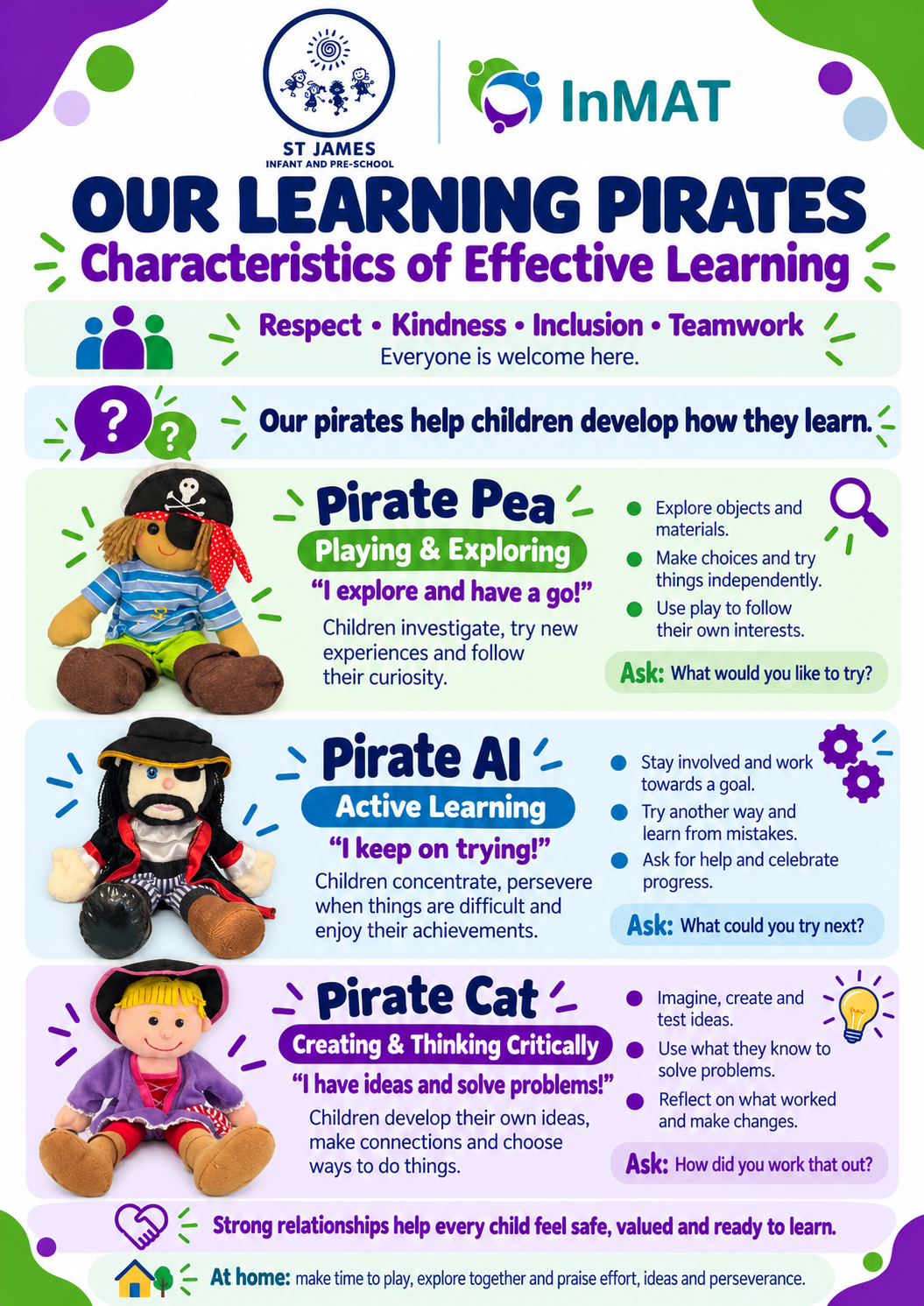
At St James, learning how to be a learner is at the heart of everything we do. Curiosity, independence, perseverance, creativity and problem-solving provide the foundations for learning across every subject and are essential skills for life.
Our Learning Pirates help children recognise and practise these skills: having a go, keeping on trying, exploring ideas and reflecting on what works. Although the Characteristics of Effective Learning come from the Early Years framework, our commitment to developing them continues throughout the whole school, from Poppies to Year 2. Through everyday teaching, play and new experiences, we help children grow into confident, thoughtful learners who can approach challenges, learn from mistakes and use these skills in school and beyond.
Phonics
Read, Write, Inc is used to teach phonics throughout EYFS and KS1.
Links to Read, Write, Inc. practice videos are posted on Class Dojo class pages.
Reading
Children are encouraged to become confident, enthusiastic, critical and independent readers. They will have opportunities to read for information, interest and enjoyment.
We achieve this through:
- Having a ’20 minute reading pledge’, where teachers and parents agree to read to their child for 10 minutes each day.
- Hosting special events like ‘Book and Biscuit’.
- Uploading a daily bedtime story.
- Providing access to ‘Oxford Reading Buddy’, which is an e-book account.
- Providing ‘VIPERS' sessions in KS1. This is a systematic way to teach reading strategies.
- Committing to listening to all children read at least once a week.
- Using ‘reading friends’ to teach children strategies to improve their reading skills.
- Providing a full, exciting library.
At home, you can nurture this enthusiasm by sharing stories, talking about adventures and inviting your child to write a card, a message or a shopping list. Every little opportunity helps them discover that their words have a purpose!
English
At St James Infant and Pre-School, we believe every child has something worth saying—and we help them discover the joy of putting it into writing!
From the first meaningful marks in Pre-school to imaginative stories in Year 2, our writing curriculum builds confidence, creativity and independence, step by step. Wonderful books, exciting experiences, role play and drama spark ideas and give children a reason to write. Talking comes first: children explore vocabulary, share their thoughts and practise sentences aloud before putting pencil to paper.
In Early Years and Year 1, opportunities to write are woven through all areas of our enhanced and continuous provision—the spaces, resources and activities children explore during their learning. Whether making a sign for a construction, taking orders in a pretend café or writing a message to a friend, children discover that writing is useful, meaningful and fun.
As children grow, they learn to shape their ideas for different purposes and readers, choosing words carefully and developing their spelling, punctuation and grammar. We use High 5 Heroes to support children as they develop and check their writing, alongside Colourful Semantics, which uses colour-coded visual prompts to help children organise their ideas and build sentences. These tools help make the writing process clear and manageable, supporting children towards greater independence.
Maths
Our mathematics curriculum is mostly taught separately as a stand-alone subject using a project-based approach. The focus is on understanding mathematical concepts and developing critical thinking and reasoning, whilst building a knowledge of basic number skills.
We achieve this by using White Rose Maths, which is a resource that helps us to:
- Ensure maths teaching relates to everyday life.
- Encourage children to become self-regulatory learners; assessing their own and peers’ work against clear mathematical goals.
- Ensure lessons are well-structured and sequenced so that children are able to work towards mastery.
- Provide well-chosen and purposeful resources.
Below is a list of activities that your child would benefit from carrying out on a regular basis:
- Reading and writing numbers to 100 in numbers and words.
- Counting in 1s, 2s, 3s, 5s and 10s.
- 2s, 5s, 10s times tables.
- Recalling pairs of numbers (number bonds) that add up to make 10 and 20.
- Recognising and naming a range of 2D and 3D shapes.
- Measuring items and reading scales using a range of measuring apparatus (rulers, kitchen scales, bathroom scales, tape measures, measuring jugs, etc.).
- Telling the time o’clock, half past, quarter past and quarter to.
- Making amounts with coins.
Forest School
We like to give our children the chance to leave the classroom and go into the great outdoors. Come rain or shine, children have hands-on experience of the natural environment.
In forest school, children learn through a range of activities that are child-directed. The scope of the activities that can take place can be enormous.
It’s very physical so it encourages children to be active, developing risk-taking, decision-making and self-sufficiency, which all boost self-confidence and esteem.

SMSC (Spiritual, Moral, Social, Cultural Education)
At St James, we help children develop an understanding of themselves, others and the world around them. We are a values school and a No Outsiders school, where everyone is welcome.
Our school values of Respect, Kindness, Inclusion and Teamwork underpin everyday school life. Through these, children explore the British values of democracy, the rule of law, individual liberty, mutual respect and tolerance of different faiths and beliefs.
We support children’s spiritual, moral, social and cultural development through:
-
Spiritual development: opportunities to reflect on feelings, beliefs and experiences, explore different faiths and develop curiosity and wonder through stories, nature, music and creative activities.
-
Moral development: learning about fairness, right and wrong, and how our choices affect others. Our restorative approach helps children reflect, repair relationships and show care for others.
-
Social development: learning to cooperate, listen, share ideas and resolve disagreements. Class discussions, shared responsibilities, school council and teamwork help children understand how they contribute to our school community.
-
Cultural development: exploring different traditions, celebrations, stories, music and art, and valuing the experiences and backgrounds within our school and wider community.
Through our No Outsiders stories and discussions, children develop an age-appropriate understanding of equality and the protected characteristics. They learn that people and families can be different, that everyone deserves respect and that nobody should be left out because of who they are.
Assemblies, educational visits, visitors, performances and community activities bring this learning to life. Home-learning challenges and competitions also provide opportunities for families to explore our values together, helping children become thoughtful, kind and active members of their community.
Home Learning
At St James, home learning helps children explore their topics and share their learning with their families. Each term, we send home ‘Home Work Splats’, offering a range of practical experiences, visits and tasks to complete with support from home. Children are encouraged to bring their work into school to share with their class, with examples displayed around the school for others to enjoy.
We also encourage daily reading—please see the Reading section of our website—and send home phonics activities, including comprehension questions and practice reading red and green words.
Throughout the year, we offer competitions, challenges and home tasks linked to our school values, Learning Pirates and British values. These help children develop their understanding of their role in society and how we contribute to, care for and work together as part of a community.
Music
During the children's time at our school, every child develops a lasting love of, and passion for, music, especially through participating in singing and other musical activities.
Music should enhance learning through:
- Participation in a wide range of musical activities.
- Providing a stimulating and non-threatening medium to develop social skills.
- Being fully inclusive and not dependent upon academic achievement.
- Developing musical skills and preferences.
RE
St James follows the SACRE locally agreed syllabus for Religious Education. Teaching and learning focus upon Christianity alongside the other principal religions, which are represented in British society.
Children are encouraged to investigate different religions, engage with their knowledge and reflect upon their learning and own lives, so they develop their ability to understand religion, beliefs and practices.
EYFS
In EYFS, children build the foundation for their learning in Religious Education by exploring similarities and differences between themselves and others, and amongst families, communities and traditions.
Key Stage One
In Key Stage One, children learn to identify similarities between Christianity and other religions through exploring family, neighbourhood and special times.
